See exactly why a call passed, or failed.
Score every call across five dimensions, on your own infrastructure.
$ uvx hotato start --demo
Everything runs on your machine.
- 3,544tests in CI
- 17assertion kinds
- 5dimensions
- 0runtime deps
Five questions, checked five ways.
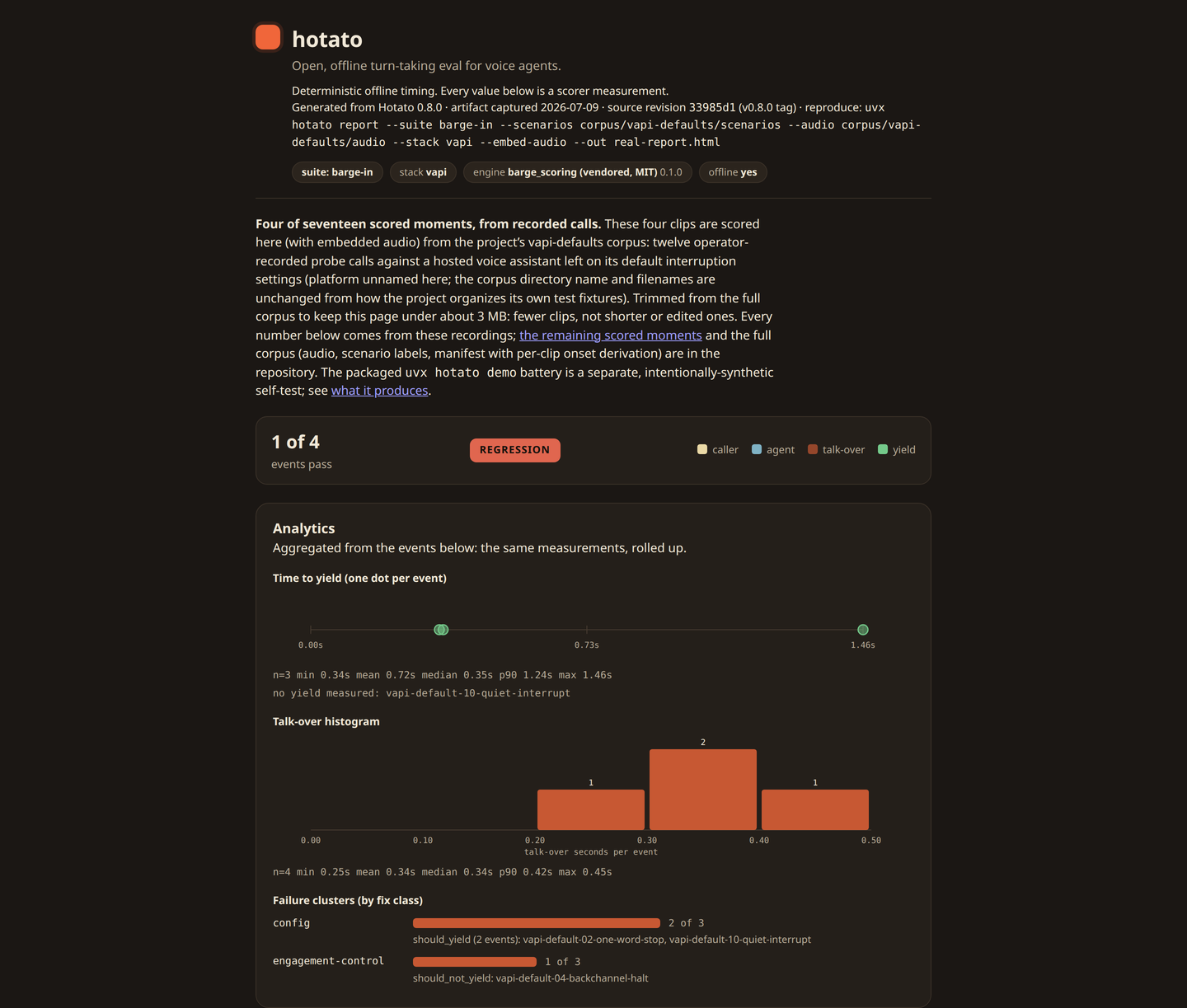
The transcript reads clean, yet the refund never fired. The scorecard says why.
- Outcome did the task succeed
- Policy did it follow the rules
- Conversation did it listen and take turns
- Speech transcript, latency, audio
- Reliability does it hold across repeats
One file. Every check.
A conversation test is one YAML file: 17 deterministic assertion kinds, plus one advisory rubric lane.
agent: support-bot
assertions:
  # 17 deterministic kinds, no model
  - kind: outcome      # refund posted to the ledger
  - kind: policy       # required disclosure present
  - kind: tool_call    # issue_refund ran, from the trace
  - kind: pii          # card number never spoken back
  - kind: latency      # reply gap under budget
  rubric:            # advisory lane, separate
    - kind: judge_rubric # deterministic:false
$ hotato test run conversation-test.yaml
  outcome        pass
  policy         pass
  conversation   fail   talked over caller 1.32s
  speech         pass
  reliability    pass^k 20/20 held
  model judge    advisory · sent to review
exit 1
Confirm it once. CI replays every commit.
A confirmed failure becomes a portable contract; CI re-scores it and exits 0 or 1.
$ hotato contract verify contracts/ --junit contracts.xmlA self-hosted control plane.
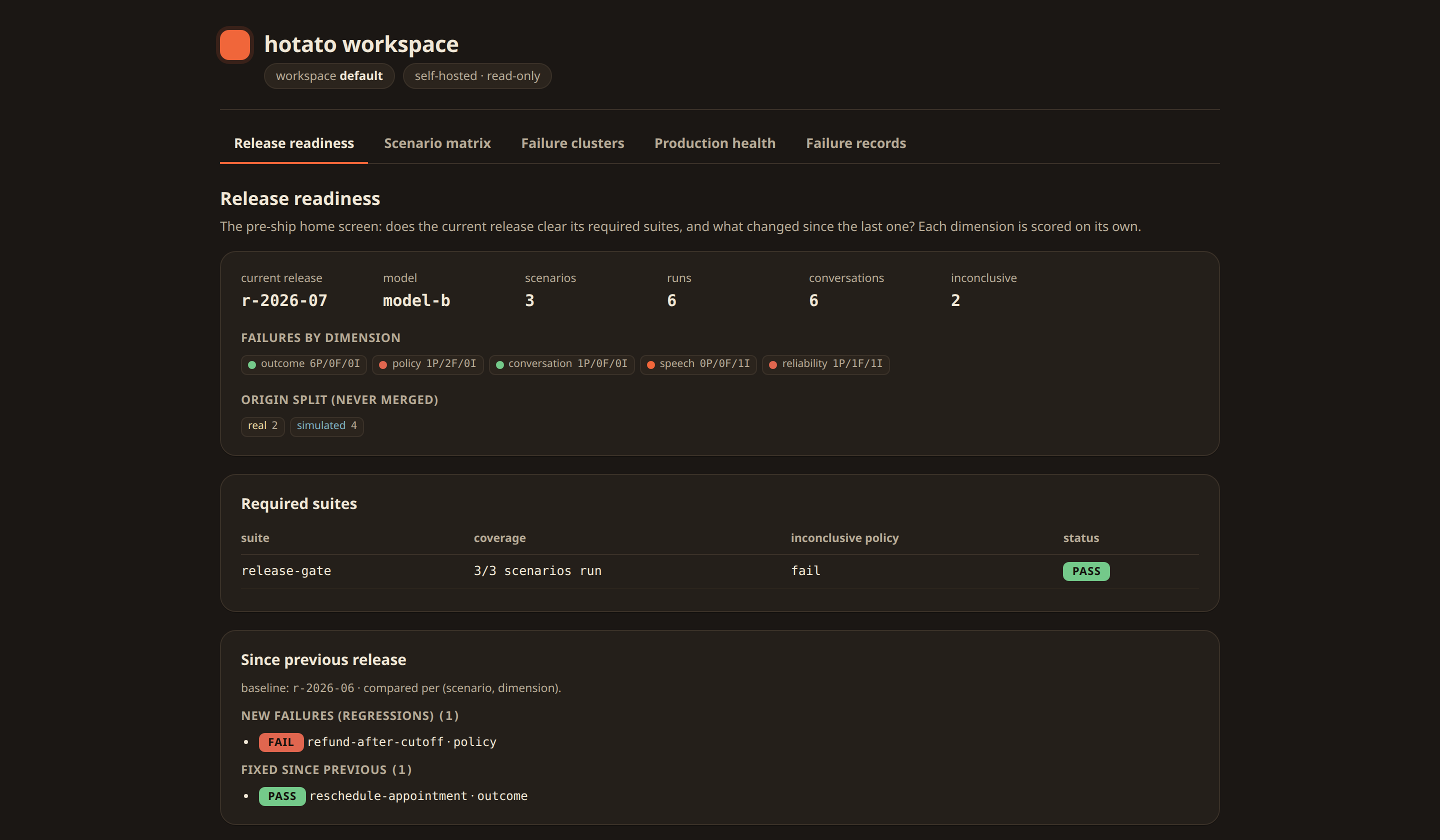
Read-only views over your registry that recommend what to look at before you ship.
- Runs in your VPC
- bearer-token auth
- zero egress
One run covers the rest.
The same command simulates at scale, times every turn, tiers your evidence, and stays offline.
Simulate & pass^k
Deterministic callers replay a scenario across seeds; pass^k reports whether it held on every run.
Simulation →Deterministic timing
Millisecond turn-taking on two channels, no model in the path. It times when each side spoke.
Timing →Evidence tiers
A machine-readable vector; recompute-from-audio and an Ed25519 signature raise the tier.
Trust & evidence →Zero egress
Offline by default; a not-scorable input is refused with a plain reason, never a guess.
Self-host →Integrations
Capture from Vapi, Twilio, Retell, LiveKit, and Pipecat, without changing your stack.
Integrations →MCP & agents
Drive every run from an agent over MCP, with machine-readable output and exit codes.
Docs →The moments no single threshold catches.
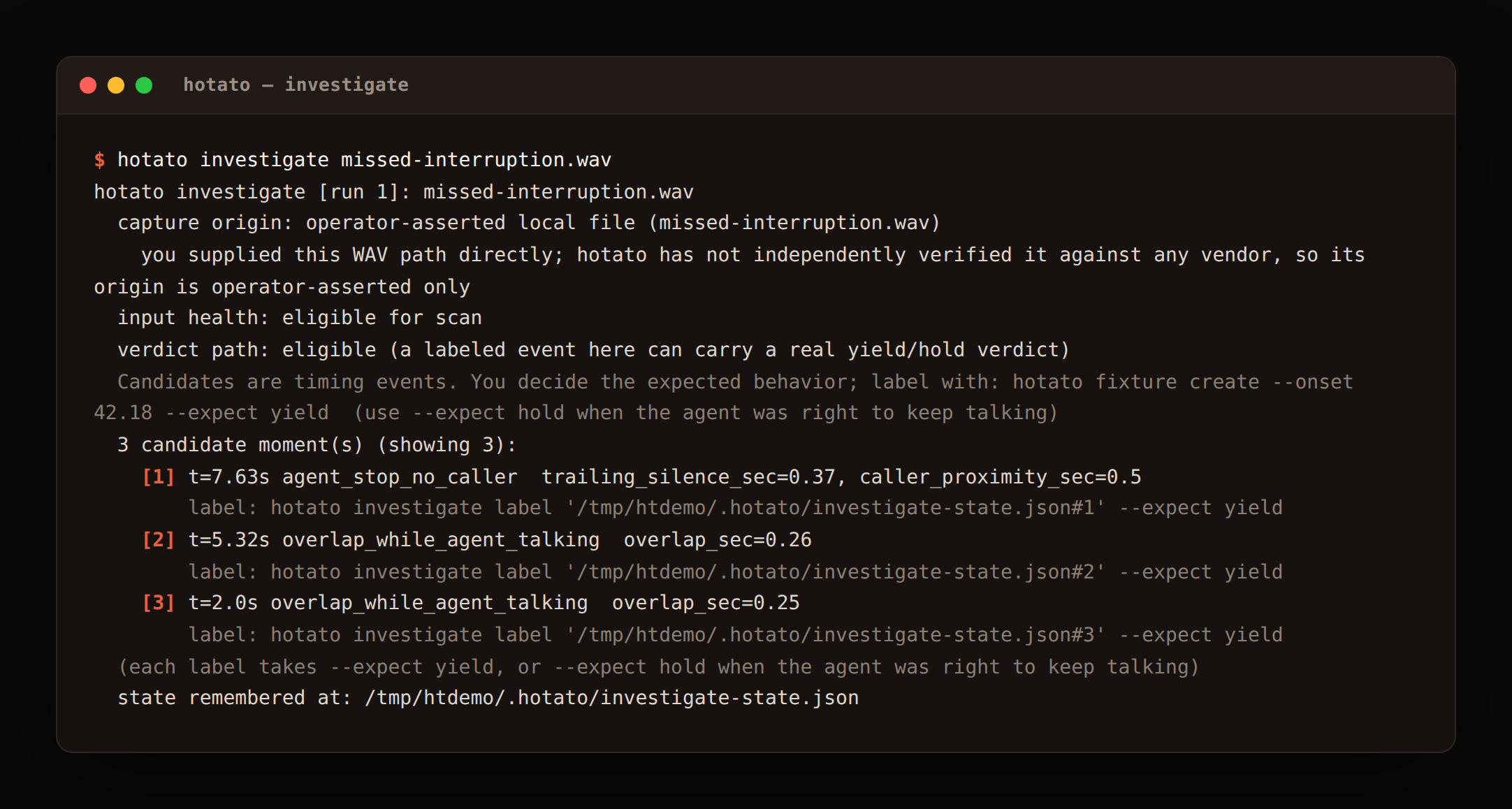
Hotato ranks the candidate interruption moments; you label each one.
Closing those moments takes engagement control at the model layer. That is what Attention Labs builds.
- your recordingcaptured
- →
- hotatoper-dimension scorecard
- →
- candidate momentsranked, you label
- →
- Attention Labsconsent + focus gated
The boundaries.
What Hotato measures, and what it deliberately leaves to you.
What's the overall accuracy score?
None, by design. Five dimensions are reported separately, never averaged into one number. The deterministic checks re-run identically, and that reproducibility gates CI.
Does it read intent, emotion, or who is speaking?
No. The timing layer measures energy on two channels and flags candidate moments for you to label; energy is not intent. It identifies no speakers: each channel already belongs to one party. A transcript is opt-in context for phrase and PII checks, never itself scored.
Can I run it on one recording?
Yes. uvx hotato start --demo runs the full flow on bundled calls, no account or network. Point it at one of your own for a per-dimension scorecard.
What does it cost?
Free and MIT-licensed, with zero runtime dependencies and no phone-home. Every dimension, the workspace, the judge, and the simulators are included.
Which voice stacks?
Capture from Vapi, Twilio, Retell, LiveKit, and Pipecat. Placing a live billed call is Vapi and Twilio only, gated. Integrations →
Does my audio leave my machine?
Not on the default path. Scoring, assertions, a local judge, and the workspace run offline. A recording moves only when you pull it or opt in. Security →

Know what your agent did on every call.
Bundled recordings, a per-dimension scorecard, and a CI-ready contract, in one command.
$ uvx hotato start --demo
One recording is enough to start. Get started → · self-host →